
Biosphere: microcosm/macrocosm - microbiome/macrobiome (demo - 09/09/26 version) No. II / ::: speculative poetics on non-human consciousness :::

1. A loose and possibly error ridden history of the Great Mother system.
The nebular hypothesis offers that around 4.6 billion years ago, the birth of this solar system (Sol System) resulted from the gravitational collapse of a portion of an unstable giant molecular cloud (GMC.)
The gravitational instability in this region of the GMC allowed for denser clumps of molecules to form, accrue mass, start to rotate and then compress to form stars.
One such star was our Sun.
The Suns's formation was accompanied by an associated ionised protoplanetary disc of gasses and dust, which itself flattened into an orbit around the young star.
From this proplyd accreted small solar system bodies, which in their turn grew through collisions, coalescing into larger bodies.
From collapse of gaseous potential into focussed mater, so formed the Sun and planets.
Similarly, a series of violent impacts likely set the conditions for the emergence of life on planet Earth.
The giant-impact hypothesis suggests that in the early stages of this solar system, proto-Earth and the hypothesised planet Theia collided, both shattering and then recombining, giving birth to a greater whole.
Earth, as she is now, was the result of the union; possessing sufficient mass for the potential retention of the fundamental element of life - water.
A satellite companion also emerged from the collision of proto-Earth and Theia, the Moon: Selene, the offspring whose gravity holds sway over the waters of Earth.
The young Earth went through what human geologists have named the Hadean eon: a hellish period of extreme heat and conditions where the planet consisted of molten rock, with no discernible crust or stable atmosphere; Earth's surface was regularly bombarded by comets and meteorites.
No water was retained; no life was present.
With time, Earth's raging temperatures gradually cooled, allowing matter comprised of silica-rich elements to float out to the surface of the planet molten amalgam, forming its crust; while the heavier iron rich material was drawn inwards to form the mantle and core.
While this settling occurred, collisions continued throughout the solar system.
The comets and asteroids that struck Earth are thought to have brought a significant amount of water to Earth's surface.
Thanks to the factors of Earth's optimal positioning from the Sun (within the 'habitable zone,') her increased mass and dropping temperatures resulted in the formation of a relatively stable secondary iteration of her atmosphere, and water began to condense on the surface of the planet.
In time, oceans formed.
Moving through roughly 0.5 billion years of the Hadean eon, Earth entered a new stage, know as the Archean eon: where single celled lifeforms began to proliferate in her warm oceans.
Speculated theories suggest life potentially emerged through one, or a combination of the following means -
- Abiogenic processes: where chemical compounds somehow over vast stretches of time and due to warm and chemically abundant favourable conditions, coalesced to form RNA, amino-acids or other organic molecules - which were then able to further evolve. Perhaps lightning and/or extreme volcanic heat of hydrothermal vents played a significant role, charging abundant inorganic compounds floating in the primordial soup, with the rudimentary spark of life.
- or, in accordance with the idea of Panspermia: the building blocks for life arrived on the meteorites and comets that fell to Earth's surface.
From these dimly understood origins, life began - archea and bacteria emerged, colonising Earth's warm oceans: in the shallows and around deeper oceanic hydrothermal vents, they fed respectively by anoxygenic photosynthesis and anaerobic chemosynthesis, adapting to the environmental conditions.
After around 1 billion or so years, a big shift came when cyanobacteria evolved to produce their energy by oxygenic photosynthesis - shifting from a chemical to a solar power source, for generating 'food.'
Meanwhile, the planet's crust shifted continually: tectonic activity broke up the supercontinents, redistributing land mass around the equator and causing minerals and nutrients to be release and subsequently dissolved into the oceans, resulting in changes in their currents and circulatory patterns.
The abundance of nutrient dense oceanic water allowed a proliferation of cyanobacteria to bloom. This exponential expansion in cyanobacteria meant more oxygenic photosynthesis taking place, which contributed to the great oxidation event around 2.5 billion years ago. Earth's iron-rich oceans ran red with rust, and almost everything teetered on the brink of extinction.
The increase in oxygen, and the changes in ocean circulatory currents (thanks to tectonic activity,) brought about changes to the atmosphere, shifting it from a warm methane and carbon dioxide rich 'greenhouse,' to a progressively cooling state, thanks to the UV shielding afforded by the oxygen rich conditions.
Ice and snow formed on the planets water-covered surface, bouncing the Sun's energy back into space, rather than absorbing and warming Earth (thanks to as high albedo factor, which further added to the cooling feedback loop.)
This marked the hypothesised stage of Snowball / Slushball Earth.
All the while life persisted beneath the icy surface, clustered around the geothermal vents. Symbiogenic adaptation occurred, and early lifeforms evolved to fill the varying niches provided by the changing conditions on Earth.
Multicellular lifeforms evolved via endosymbiotic processes: bacteria were absorbed by larger prokaryotic cells, bringing about the formation of organelle cells which served specific purposes around generating energy - mitochondria.
Over time, these symbionts developed further into eukaryotic cells with membrane-bound nuclei, giving rise to further specialisation: predatory cells - the first protozoa, powered by mitochondria; some later developing cell walls - fungi, and those with chloroplasts - plants; but not necessarily in a linear developmental fashion.
Multicellular lifeforms held the edge in adapting to the changing climate.
Earth had move through the Hadean, to Archean, to Proterozoic, and into the Phanerozoic eon: the age of visible life.
2. Bacterial Technologies.
Across the eons, bacteria have persisted; they hold in their collective memory the dim recollection of beginnings.
The views on their origins vary, but regardless, across the vast spans of time that bacteria have been on Earth, they have taken a progressive approach to life.
From a bacteriocentric perspective, what humans view as evolution was simply bacterial technological development: harnessing the larger prokaryotes was the first significant step in bacterial machinery.
In the larger scheme of things, it was not long before bacteria developed progressively more complex multicellular technologies.
From the early stromatolitic cities that populated the warm Archean eon, through to oxygen-tolerant adapted protozoa, evolving into expanding ecosystems of complementary complex systems.
Since life emerged, bacterial empires swelled, ebbing and flowing in the wake of extinction events, only to adapt and surge again.
Their technology took a huge leap forward at the advent of meiosis in the new lifeforms that the bacteria were cultivating - where diploid cells containing a complete set of chromosomes could be broken down into haploid gametes, which could then be fused in a variety of surprising combinations to driver further adaptation. All the better, the new constructs started to reproduce with greater variety and advanced emergent adaptations.
After a long succession of R&D, their greatest creative success came during the Mesozoic era, when Dinosaurs ruled Earth: a clean and long-lasting and highly biodiverse project of bacterial ingenuity; it was a real shame about the asteroid and resulting mass volcanic reaction of the Deccan traps.
The bacteria rallied and built anew.
All went quite well, with investment leaning more heavily into smaller and better adapted lifeforms in the Animalia kingdom: more efficient and compact reptiles, amphibians, interesting species of bird, mammals and marsupials.
The mammals soon became the new golden child project - seeming better adapted to the new post-apocalyptic terrain, proliferating, evolving and diversifying at a surprising rate.
Things started to get a bit scary when an overly ambitious R&D department got heavily invested into new lifeforms descended from apes...
Early iterations of these models looked promising.
However...
The trouble really started with the emergence of Homo Sapiens.
These biotechnological models started to try and think for themselves, ran away from the programming installed by their bacterial creators, and began to destroy the environment that had been so meticulously crafted to support all life on the face of Earth: their parasitic function outstripping the contributory-mutualistic drives.
That was just how it went, the bacteria adapted to keep pace with their constructed human-technology, which was now seemingly autonomously advancing well outside of the bacteria's original design parameters.
Now, cognitively emancipated from their creators and predictably viewing things through an anthropocentric lens, thanks to their own technologies and 'science,' the humans were waking up to an interesting facet of their biology: that what they view as their own cells are likely matched in a ratio of 1:1 by endosymbiotic bacteria - their mitochondria.
Further, regarding health, wellbeing and longevity, humans have developed an interest in cultivating the gut microbiome, which is shown by their studies to have multiple benefits to overall health and wellbeing for the individual. Humans are even open to the idea that their microbiome can impact desire for certain types of food-stuff, and have effect upon their moods (as the majority of serotonin is produced in the gut.)
Happy bacteria, happy human. 30 plants a week, fermented foods, polyphenols, good hydration, etc.
Here, the anthropocentric perspective has obscured the reality - the individual isn't cultivating their microbiome.
The microbiome has long been cultivating them.
Where really does the bacteria end, and the 'separate' human start?
Really, there can be no separation - although many humans may consider themselves separate and self-determining individuals.
Perhaps bacteria and humans share similar vices - hubris.
Humans... Homo Sapiens, have evolved into the runaway technology of bacteria, who sought to construct ever more advanced technological artifices.
That human constructed A.I. is poised repeat a similar rogue pattern, is an irony not lost on the bacteria.
3. Shedding.
(One human - or any animal, is a bacterial mega-city - symbiotic in nature. A host to the bacteria which make it function.)
This host has taken its final breath, inhaling strange hybrid-spore, floating on the golden rays of an evening breeze.
In a matter of moments, very strange things happened to its consciousness - the human stopped being itself and became the whole universe. Just for a few seconds.
Sadly, the bacteria could only monitor the physiological effects, so the enormity of the experience for the human was lost on them, somewhat.
Had they seen into the human's remarkable momentary experience for a human, they might be impressed that the human had such an experience. But the experience in itself was not uncommon to the bacteria's collective conscious. They were many and one, simultaneously.
The bacteria had still yet to get a good connection to see into the 'mind's eye' of their human homes... But the readouts from the life-support monitoring systems provided a veritable pyrotechnics display of unprecedented data. It was as if all of the constituent components of the human synchronised in the most beautiful harmony for just a few seconds, and then the heart stopped.... and soon after all electrical activity in the brain ceased.
Dead.
The constructed host unit had served many, many generations of bacteria as a fitting home.
It had been responsive to early programming, thanks to the hereditary components of being born into a supportive environment, to parents that themselves had been free of overly damaging challenges. It had been quite a successful venture for the bacteria.
But now, it was time to move out.
At a transitional life stage, we may take stock and reflect upon how we got to where we are...
For the bacteria, that reflection stretched back a long way.
Considering historical development of animals at large - things had become increasingly more complicated once the bacteria had worked out how to get the fatty mass in the skulls to function with greater capacity.
For some reason, the succession from broadly mammalian, to primate, to human models were just progressively more receptive to brain expansion. It was a heady whirlwind of development for the bacteria. The outcome at this stage was that the rational human emerged - Homo Sapiens.
And so, the humans used their rational faculties to search for knowledge and meaning. They examined the world from which they arose, and decided to try to bend it to their will.
The bacteria were somewhat proud of their constructs' advances; although, to the bacteria, the human term 'gut-brain-axis' felt like an insult: really, there was little true volition in the humans; the primal instinct held sway, yet...
In earlier models of hominid, the biochemistry of social relationships had an unexpectedly high factor of shaping the overall stability of the model.
Things were changing now that the Homo Sapiens had constructed these strange silicone-based mirror objects; the machines they idealised and aimed to shape themselves after.
The gut brain axis was breaking down due to a severance in relation with Earth's own nurturing bosom.
The humans just were not interacting enough with Earth and the ecosphere.
Worse, they were ignoring how they poisoned their life-support system with the byproducts of their own progressive efforts to know and control, and so poisoned themselves.
The bacteria at large as yet held fairly stable, despite what the humans had cutely named the dawn of the Anthropocene.
The bacterial lifecycles allowed for significant evolutionary leaps, where the humans was much slower to adapt to this new industrialised world-state: gut-instinct-connectivity was subordinated to top down rogue human intelligence, forcing an inhospitable world into being.
The bacteria noted the brief changes and adapted - nothing was as tough as the conditions of the Hadean eon, from which they had originally emerged.
The humans rebelled further against their makers; antibiotic weapons flushed the human systems and those of the other species (their so-called 'livestock') which they 'domesticated' (or we could say - enslaved.)
The crumbling symbiotic relationship for many of the constituent parts of the biosphere was becoming untenable.
The careful balance was disrupted in the living bodies of the bacteria's biotech constructs: the mammals seems particularly affected: newer models hadn't had all the 'bugs' worked out, and the humans kept messing about with their selective breeding programs and genetic alteration attempts, which only served to destabilise millennia of the bacterial collectives' careful work.
But, the bacteria could empathise: accidents happen.
There were instances where bacterial colonies would inadvertently migrate from favourable regions within the massive constructs within which they made their homes, crossing into sensitive systems and creating issues and even serious damage; from minor uncomfortable 'infections' to serious and disruptive cases of 'sepsis.' If death resulted in the construct, this was not cataclysmic to the bacteria. The construct could be broken down and fed back into the system - recycling was part of existence.
Focussing back on the microcosm of the unit in question - a whole/part of the broader presently-sketchy-looking macrocosmic biosphere system...
Thanks to human post-industrial world conditions and modern medicine, this unit in particular had managed to seriously alter its gut-brain axis, go rogue and long outlive what was deemed to be an optimally functioning window of utility to the bacterial generations that had made it their home and contributed to its running. The bacteria were impressed by this, and glad to get to delay the metaphorical process of selling their furniture, as it wouldn't fit in a new place.
The colonies had changed many times over the years, with momentary extinctions, flushing, hostile take-overs by different strains, but homeostasis was overall maintained. But, the light dwindled, telomeres shortened, the venerated mitochondria were depleting and the ATP energy production system was winding down.
The bacteria had anticipated an end.
But this particular end was not what they had bargained for - this strange eruption of harmonious function of a moment, to then be followed by a flat line.
And so, the time was now come.
Exodus.
But not first without demolition.
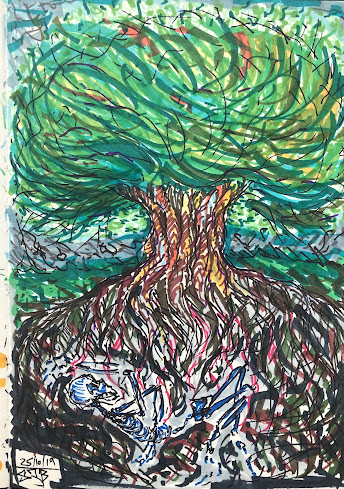
As the body of the unit was mourned, wept over and interred by its fellow biotech-construct-hominid-collective, the bacteria were at work inside; the dismantling process was well under way.
From within, the unit was deconstructed and the internal colonies made their way to available exits.
There was a sense of business as usual, but the moment one colony migrated into the skull-chamber and began to devour the fatty mass within, a strange shift occurred; something alien - the spore had entered the human's system, providing an unprecedented proliferation of synaptic neurogenesis to be have occurred within the brain - what the bacteria found the human to consider as some kind of awakening through psychedelic experience, provoked by the strange spores that had invaded the sinuses and crossed the blood-brain barrier.
The spores themselves were unlike anything the bacterial colony had ever encountered - a multifaceted new organism that seemed to hold characteristics from all Kingdoms of life - a perplexing hybrid.
Those first making entry to the brain we hit by a jolt of the energy the spore carried - which resonated out through the broader bacterial collective. A taste of familiar interconnectedness, but with an unfamiliar flavour. New information was suddenly present within the field of the bacteria's shared morphic resonance. They now seemed to have a sense of what it felt like to be animal, fungus, algal... even human.
From examining the hardware as they tore it down, it seemed the hybrid spore had created huge growth in the brain - such as the unit's own consciousness may have exploded at an exponential yet unsustainable rate - explaining the readouts of momentary near 100% optimal function, then death.
The demolition team wondered what the unit may have experienced, on the cusp of it's death - having experienced the spore, they had a taste for what it was.
Information was fed back into the collective bacterial species consciousness about this strange aberration - making connections, finding meaning, provoking further questions.
The bacterial collective knew everything about the Homo Sapiens, they were after-all their creators - but the bacteria still saw the humans as generally alien; historically knowing nothing of the nuance of human experiencing - only able to extrapolate rough approximate concepts via very complex calculations, grounded in their own unified bacteriocentric experiencing.
The bolt of information flooded the collective bacterial awareness: already known - that the so called intelligent apes knew that another extinction event was possible; that they were aware they had a strong hand in irreversible changes to the bio-systems of Gaia/Earth; that there was a strange mixture of emotion - pride, guilt, fear... But this human, it had seen beyond the carefully structured psychological shielding (that made each human consider itself an 'individual...' more to keep them manageable than anything else.)
This human, in its moment of clarity, had perhaps tasted a slice of the superconsciousness of the bacteria which underlay all sentience, and beyond that to the universal consciousness which the bacteria themselves were a channel for.
This revelation gave the bacteria pause... Maybe the humans had far more potential to be dangerous than they first thought... Not content to pollute the biosphere, maybe the humans had the capacity to touch and contaminate unity-mind with the detritus of their own limited consciousness bandwidth?
A shudder of caution passed through the bacterial collective awareness.
Never mind, the humans probably wouldn't last much longer, anyway.
The bacteria already had plans for the next model up - which they hoped might emerge in the not-too-distant. They were just biding their time waiting for the next great filter event to come along and clear the slate.
The bacteria left the cooling body of their previous home to the worms, insects and other carrion eaters, making their way through the rotting boards of a crumbling coffin, down into the soil to commune with the awaiting mycelial hyper-network.
To spread the word.
(Words and images, copyright - S.J. Bloxsidge.)


Comments
Post a Comment